
Caulking before or after painting? Before, almost always. Caulk the gaps first, let it reach its paint-ready time, then paint over it, so the caulk line disappears into the finish and the paint seals it. On bare or new wood, the order is prime, caulk, then paint, because caulk grips primed wood far better than raw wood.
The main exceptions are pure silicone around tubs, sinks and counters, which can’t be painted, and small touch-ups after a house settles. And on every exterior painting job, there are a few joints we leave open on purpose, because caulking them traps water.
How We Order It: Prime, Caulk, Then Paint
The short answer to caulking before or after painting is before, and the reason is simple. Paint over caulk hides the line and protects the caulk from sun and weather. Caulk over paint leaves a bead sitting on top of the finish, where it shows, collects dirt and can’t be covered without another coat.

On bare or new wood, primer comes first. Raw wood soaks moisture out of the caulk and gives it a dusty surface to grab, so it pulls away sooner. Primed wood gives it a sealed, even surface to stick to. So the order on new trim, doors and repaired wood is prime, caulk, then paint.

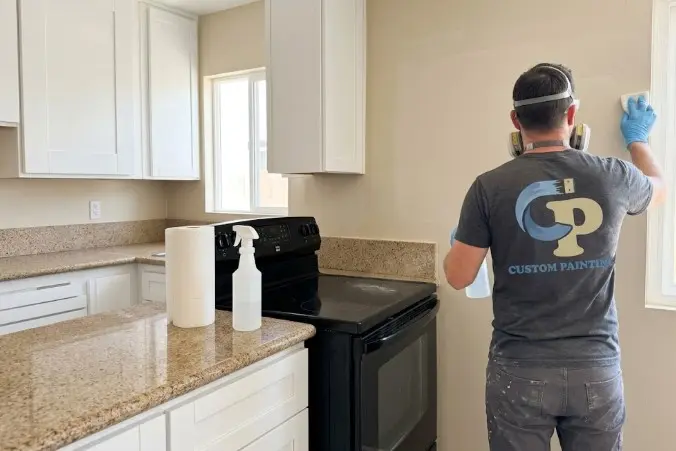
Caulking is one step in a bigger wall prep process, and it only works if the surface under it is clean, dry and sound.
When We Caulk After Painting
There are three times caulk goes on last.
Wet areas. Around tubs, showers, sinks and countertops, we use pure silicone because it handles constant water best. Paint won’t stick to it, so it goes on after the walls are painted, in clear or a matching color.
Touch-ups after settling. New homes and additions move for a while. A hairline gap that opens up at a corner after the paint job can be filled with a color-matched paintable caulk and touched up.
Stained or natural wood. Where wood is stained or clear-coated rather than painted, a caulk tinted to match goes on after the finish, since there’s no paint to cover the line.
Which Caulk We Paint Over
The label tells you whether a caulk is paintable, and it matters more than the brand.
| Caulk type | Paintable? | Where it fits |
|---|---|---|
| Acrylic latex | Yes | Interior trim, baseboards |
| Siliconized acrylic | Yes | Exterior trim, windows |
| Pure silicone | No | Tubs, sinks, counters |
| Polyurethane | Usually, once cured | Concrete, high-movement joints |
Can you paint over silicone caulk? No. Paint beads up and peels off it, and even primer struggles to hold. If old silicone sits where you want paint, it has to be cut out and the surface cleaned of every trace before a paintable caulk goes in. On our jobs, we use Sherwin-Williams 950A Siliconized Acrylic Latex Caulk on interior trim, SherMax Urethanized Elastomeric Sealant on exterior trim, and Sherwin-Williams Loxon S1 polyurethane sealant on stucco.
How Long We Let Caulk Dry Before Painting
How long should caulk dry before painting? As long as the tube says for its paint-ready time. That’s not a dodge: some fast-drying caulks are ready in under an hour, while others need most of a day, so there’s no single number. With the caulk we use most, we wait about an hour before painting.
Orange County weather moves that number around. On a hot inland day, caulk skins over fast but can still be soft underneath. Near the coast, a cool, damp marine layer in the morning slows it down. A thick bead in a wide gap also takes longer than a thin one. We go by the label and then check the bead itself before any paint touches it.
How We Handle Stucco Cracks
Most Orange County homes are stucco, and stucco is where caulk most often makes a paint job look amateur. A smooth bead of caulk across a textured wall stays smooth after it’s painted. From the street, it reads as a shiny stripe running through the texture.

For hairline cracks, we fill with a flexible, paintable patch, then texture the surface to match the wall around it before painting. Done right, you shouldn’t be able to find the crack once the wall is painted.
Wider cracks, cracks that keep growing, or stair-step cracks along block or around windows are a different matter. Have those looked at before painting, because they can point to movement that caulk won’t fix.
Joints We Never Caulk
More caulk isn’t always better. Some gaps on a house are there to let water out, and sealing them traps it inside the wall.
Bottom edges of lap and fiber cement siding. Where one board overlaps the one below, that bottom edge is a drip edge. Caulk it shut, and any water that gets behind the siding has nowhere to go.
Window weep holes. The small slots along the bottom of many window frames drain water that collects in the track. Caulking or painting them closed sends that water inside instead.
Stucco weep screeds. The metal strip along the base of a stucco wall is designed to let moisture out of the bottom of the wall. It should stay open.

Why Caulk Cracks After Painting
When caulk cracks or wrinkles under fresh paint, it’s usually one of three things. It was painted before it was ready, so the paint dried over a soft bead that kept shrinking. The bead was too thick, so the surface cured while the inside was still moving. Or the caulk was too stiff for the joint, like a cheap acrylic in a gap between wood and stucco that expands and contracts every day.

Old caulk that has failed can’t be fixed by caulking over it. It has to come out. On a 1980s ranch-style home in Dublin, CA, the caulk around the windows had shrunk, cracked and pulled away from the siding, leaving gaps wide enough to slide a business card into.
We cut it all out, cleaned the joints and spot-primed any bare wood, ran new SherMax Urethanized Elastomeric Sealant, and waited until the next morning before painting. Two summers later, every joint is still tight with no cracks or gaps.
Questions We Get About Caulk
Should I remove old caulk before painting?
Remove any caulk that’s cracked, shrunk or pulling away, and always remove old silicone, since you can’t paint over silicone caulk. Paintable caulk that’s still soft and firmly stuck can stay and get painted.
Do painters caulk as part of a paint job?
A good painter does, because gaps left open show through the finish and let water in. On our jobs, caulking is part of the standard prep in every proposal, along with cutting out failed caulk where we find it.
Let Us Get the Details Right
Caulk is a small part of a paint job that decides how the whole thing looks up close and how long it lasts. Ask for a free estimate, and we’ll show you which joints need new caulk, which need to come out, and which should stay open, all backed by our 24-month workmanship warranty.