How many coats of paint for a ceiling? Usually two. If the ceiling is already white, in good shape and getting the same color, one coat of a quality ceiling paint can be enough. New drywall, water stains, smoke damage or a change in color need a primer first, then two coats.
Water stains need a stain-blocking primer specifically, or they’ll bleed right back through. Popcorn and acoustic ceilings are their own job: they’re usually sprayed rather than rolled, and older ones should be tested for asbestos before anyone scrapes them. Here’s how we decide the number on our interior painting jobs.
How We Count Coats on a Ceiling
The honest answer to how many coats of paint for a ceiling starts with what’s up there now. Here’s how it usually shakes out:
| Ceiling now | Primer? | Coats |
|---|---|---|
| Same white, good shape | No | 1 to 2 |
| Color change | Often | 2 |
| New drywall | Yes | 2 |
| Water stain or smoke | Stain blocker | 2 |
| Popcorn or acoustic | Test first | Sprayed, 1 |
We look at the ceiling during the estimate and tell you which row you’re in. That way the number of coats is in the proposal, not a surprise halfway through.
When We Tell You One Coat Is Enough
Is one coat of ceiling paint enough? Sometimes, and we’ll say so when it is. If the ceiling is the same white you’re keeping, the old paint is sound, there are no stains or patches, and we’re using a quality ceiling paint, one even coat can look just as good as two and save you a day of labor.
It stops working the moment anything on the ceiling is different. Patches and repairs soak up paint differently than the area around them and show as dull spots, called flashing, under a single coat. A color change, even from one white to a slightly different white, usually shows through. And ceilings near big windows are less forgiving, because side light picks up every thin spot.

When We Prime a Ceiling First
Do you need to prime a ceiling before painting? Not always, but you do in four situations: new drywall, water stains, smoke or nicotine, and a big color change. New drywall needs it because the paper and the joint compound soak up paint at different rates. Without primer, the seams show through the finish.
Water stains are the one people get wrong most often. Two coats of regular ceiling paint over a brown stain usually look fine for a week, then the stain bleeds right back through. It takes a stain-blocking primer, and only after the leak is fixed and the drywall has dried out.
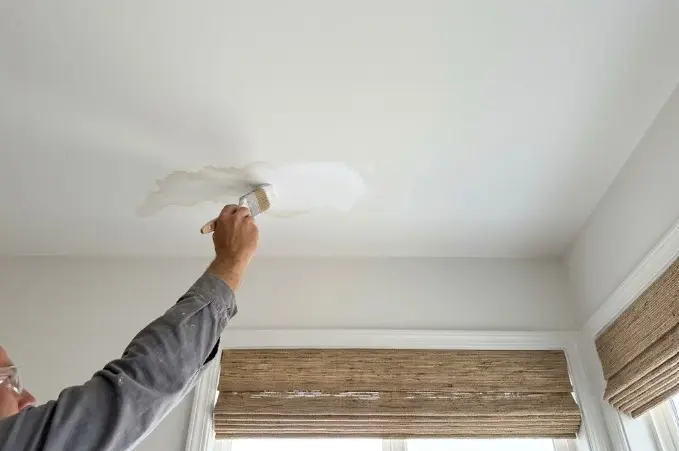
If the stain is in a bathroom, the cause is often moisture rather than a leak, and it’s the same reason so many bathroom ceilings peel. Fix the ventilation, or the stain comes back.
How We Handle Popcorn and Acoustic Ceilings
Plenty of older Orange County tract homes still have popcorn or acoustic ceilings, and they don’t follow the same rules. The texture is soft and loosely bonded. Push a wet roller across it, and the paint soaks in, gets heavy and pulls chunks of texture down onto the roller and the floor.
So we spray them. A sprayer lays the paint on without pressing on the texture, and it gets into every bump that a roller would skip. It does mean masking the walls, windows and floors completely first.

One caution before anyone touches an older textured ceiling: acoustic ceilings installed before the mid-1980s may contain asbestos. Painting over intact texture doesn’t disturb it, but scraping, sanding or patching can.
If your home is that age and you’re thinking about removing or repairing the texture, have it tested by a certified lab first.
Why Ceilings Look Patchy, and How We Avoid It
Ceilings are harder to get right than walls because of how light hits them. Daylight from a window skims across a ceiling at a low angle, which throws a shadow on every ridge where one roller pass overlapped a pass that had already started to dry.

A few habits prevent most of it. We cut in the edges first and roll while the cut-in line is still wet, so it doesn’t show as a frame around the room. We keep a wet edge, working in sections small enough that each pass rolls into paint that hasn’t set.
The final passes run toward the main window, so any roller lines follow the light instead of crossing it. And we use a flat ceiling paint, because any shine at all shows every pass.
What We Use on Ceilings
We work with Sherwin-Williams and Dunn-Edwards products. For most ceilings, that means Sherwin-Williams ProMar 200 Interior Latex Flat Ceiling Paint, a flat finish made to hide roller marks and small flaws. Where stains or new drywall call for primer, we use Dunn-Edwards Super-Loc Stain-Blocking Primer. We pick these two because the ProMar goes on evenly with a roller and dries to a uniform flat finish, while the Super-Loc locks down water stains and seals new drywall so the color stays consistent.

FAQ: Questions We Get About Ceilings
How long should I wait between coats on a ceiling?
Go by the recoat time on the can, which for most latex ceiling paints is a few hours, and longer on cool or humid days. Rolling the second coat too soon drags up the first and leaves rough patches.
Should the ceiling be painted before or after the walls?
Ceiling first. Any drips or roller spatter land on walls that haven’t been painted yet, and the walls can be cut in cleanly against the finished ceiling.
Let Us Look Up for You

We’ll tell you honestly whether your ceiling needs one coat, two, or primer first, and put it in writing. Ask for a free estimate, and every ceiling we paint is backed by our 24-month workmanship warranty.