


I am the owner of Custom Painting & Decorating Inc. in Orange County. I learned the trade as a kid, working alongside my father on painting jobs across Southern California, and started the company in 2018. With 20+ years of experience and 500+ projects completed, I write about what actually happens on a paint job so homeowners know what to expect before they hire.
A stained railing can be painted and hold up for years, as long as the old finish is cleaned, stripped, sanded and primed with the right primer before any color goes on. When those steps get skipped, the paint never really grabs the wood, and it turns soft and sticky under your hand.
That second outcome is something we see more than we’d like. Railings get handled more than almost anything else painted in a house, so they show bad prep faster than walls or doors. Here’s a short clip where we talk through it on site.
View this post on Instagram
Skipped Prep Leaves Paint Soft and Sticky
Paint brushed straight over a glossy stained finish has nothing to bite into. It can look fine for a few weeks. Then hands start sliding along it every day, and it turns tacky, smudged and uneven. The best way we can describe it to homeowners is paint that feels like toothpaste: gummy, wrinkled in places, and never fully hard.
When paint turns gummy on a railing, it almost always traces back to one cause: a surface that wasn’t ready. Most of these prep failures show up within the first few months, long before the rest of the room needs attention.
We ran into this on a staircase in Orange County, where the finish an earlier painter left on the handrail had gone soft in some spots and crackled in others. The homeowners wanted the stained wood turned to a clean white, and they wanted it done so it would last this time.
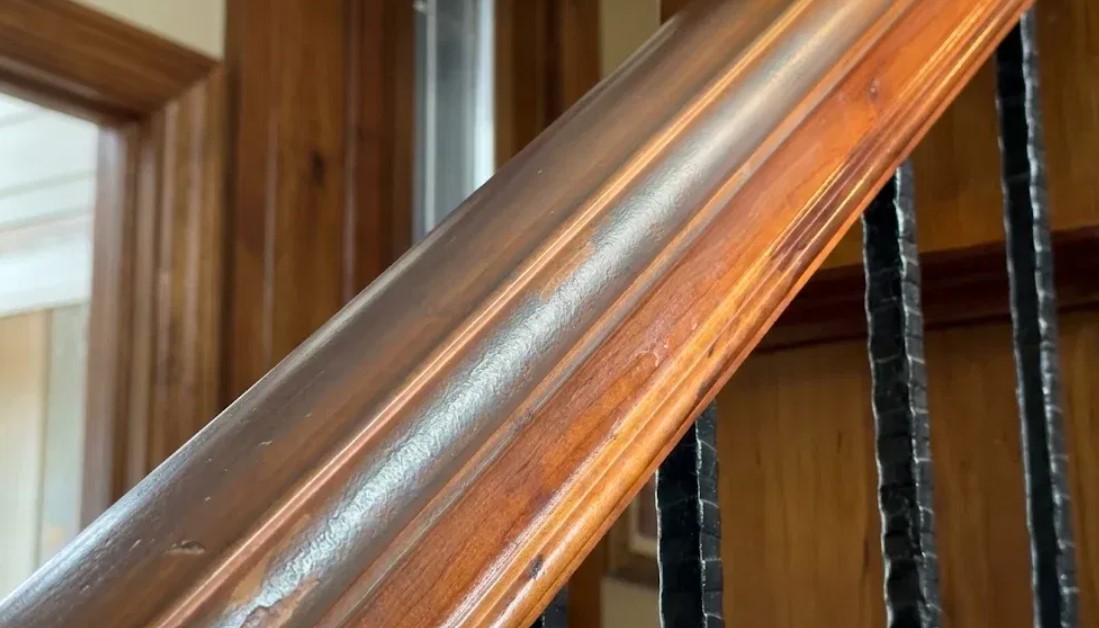
Patching over a finish like this only buries the problem. Once a coating has failed, whatever goes on top of it fails along with it, so the real fix is taking the rail back to a surface that will hold.
Cleaning and Degreasing Come First
Every handrail carries years of hand oils, lotion and everyday grime, and none of it shows until paint refuses to stick. On this rail, we cleaned and degreased every inch before any sandpaper came out. Sanding a dirty rail just pushes that film deeper into the wood.
It’s the same thinking behind how we handle prepping a wall for paint. Whatever sits on the surface decides how long the finish lasts, and a railing just gets tested harder.

The Old Clear Coat Has to Come Off
Stain sits under a clear protective layer, usually a varnish or polyurethane. Painting over varnished wood without removing or breaking that layer is a lot like painting glass. The paint dries on top, but it never locks in.
So after cleaning, we stripped the clear coat and sanded the rail, the half wall cap and its molding down to a dull, even surface. This is the slow part of the job and the one most often cut short, because nobody sees it once the color is on. It’s also the step that decides whether the finish lasts.
On staircases with wood balusters, every spindle and handrail goes through that same sequence, including the tight turns where hands rarely reach but dust collects.
The Right Primer Is What Makes Paint Hold
Most of the work in painting a stained wood stair railing happens before any color comes out, and the primer is the last piece of that prep. There’s a specific primer for going from stain to paint. We use a Sherwin-Williams Extreme Bond Primer made to grip slick, previously finished wood, and it also helps keep the stain’s color from bleeding up into a white topcoat. A standard wall primer doesn’t do either job well.
Painting a stained banister without that primer is behind a lot of the sticky, uneven results we end up fixing.
Spraying Gives the Cap an Even, Hard Finish
The stairway has a handrail along the steps and a half wall at the upper landing, and the cap on that half wall is the part we sprayed. Before primer and paint went on, we wrapped the windows and nearby walls in plastic and taped every edge, then sprayed the half wall cap and its molding.
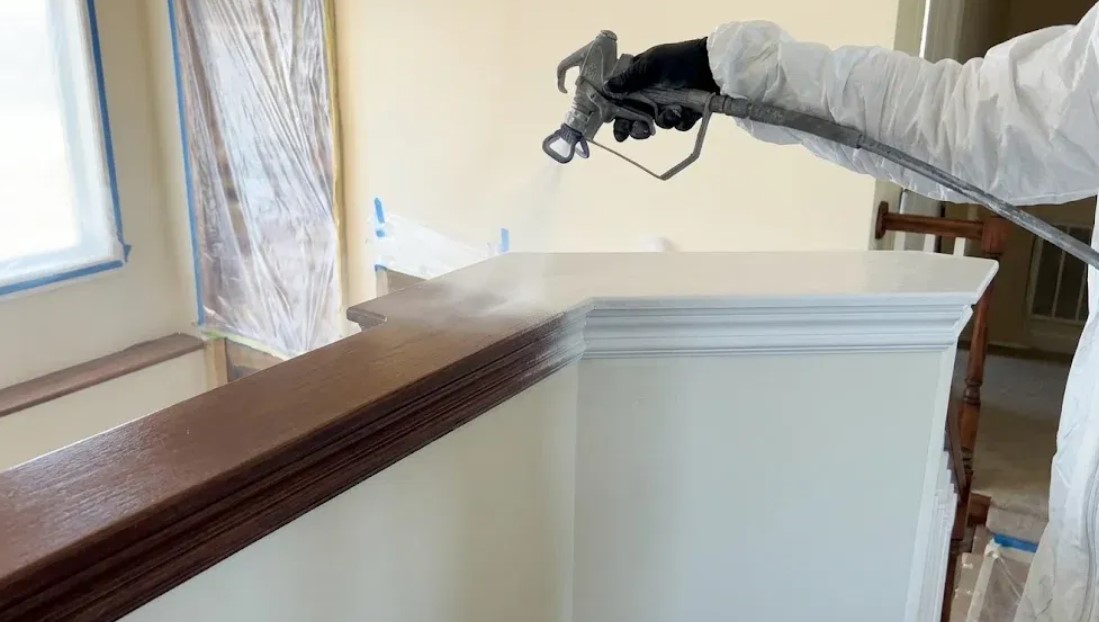
A sprayer lays the coating into each profile without brush marks, which matters on a surface people run their hands along every day. The cap got two finish coats over the primer. The handrail along the steps got the same cleaning, stripping, sanding and primer, and was brushed with the same two finish coats. If you’ve seen a stair railing paint job that looks streaky or thick in the corners, it’s usually brushwork fighting a surface that was never ready for it.
A Good Finish Feels Smooth and Stays Hard
White shows every flaw, so the result is an honest test of the prep underneath. Here the cap and molding came out smooth and glossy. The stained posts and baseboard stayed as they were at the homeowners’ request, which keeps some warm wood around the stairs.
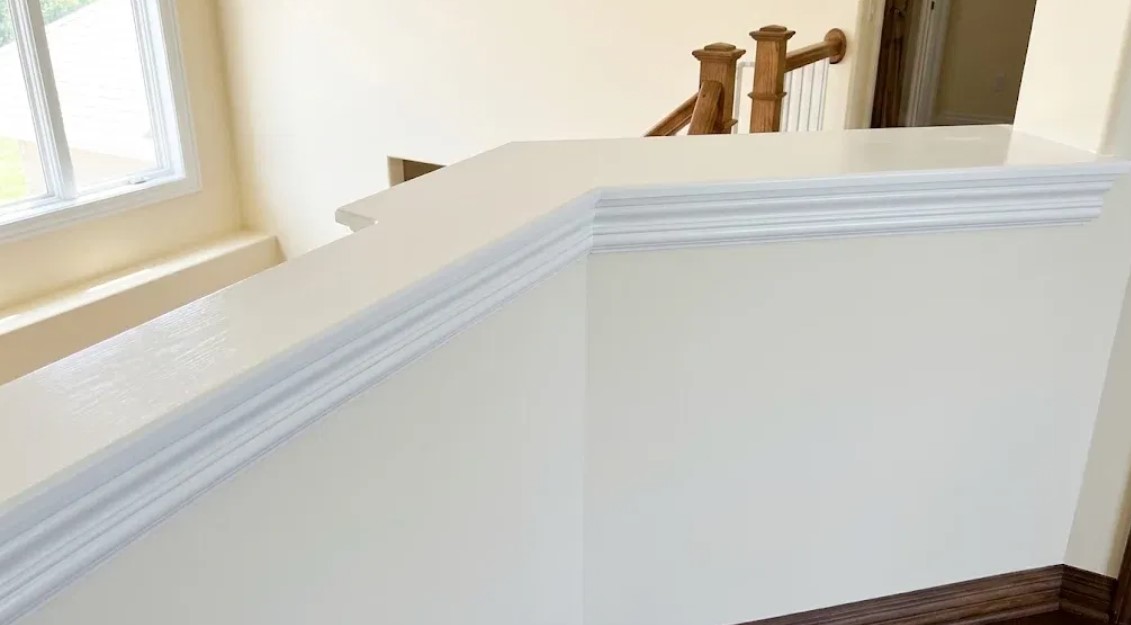
Fresh paint needs time to harden before it takes heavy daily use, so we ask homeowners to go easy on the rail for a while after we finish.
Stair work like this is part of our interior painting work, and it comes down to care more than anything. We want you to walk past that rail and feel the difference, the way these homeowners did.
FAQ
Can any stained railing be painted?
Most can, as long as the wood is solid. Rails with deep cracks, loose joints or wobbly posts need repairs first, because fresh paint will highlight every gap and movement instead of hiding it.
Why does paint on a handrail feel sticky months later?
Usually the coating never bonded to what was under it. Oils, wax or a glossy topcoat kept it from gripping, so it stays soft. Adding another layer won’t fix it; the old finish has to come off.
Do you paint the iron balusters too?
We can. Metal balusters need their own cleaning and a primer made for metal, so we quote them separately and match the sheen to the rail if you want everything painted the same color.
Can I keep the posts stained and paint only the rail?
Yes, and it’s a popular look. We tape and protect the stained parts carefully so the line between wood and paint stays crisp, then touch up any spots where the two meet.
How long does the work take?
Most staircases take a few days, since cleaning, stripping, sanding and priming each need their turn before color goes on. Larger stairways with many balusters or two levels of rail can take longer.
A Rail That Stays Hard Under Your Hand
A painted rail should feel smooth and solid for years, not tacky after one season. If an old stain has you ready for a change, or an earlier paint job has turned soft, reach our office with a photo of the rail, and we’ll tell you what it needs before anyone picks up a sander.